 10MathQ
Study guides › Level 10 · Calculus
The power rule: derivatives of xⁿ
💡 The idea
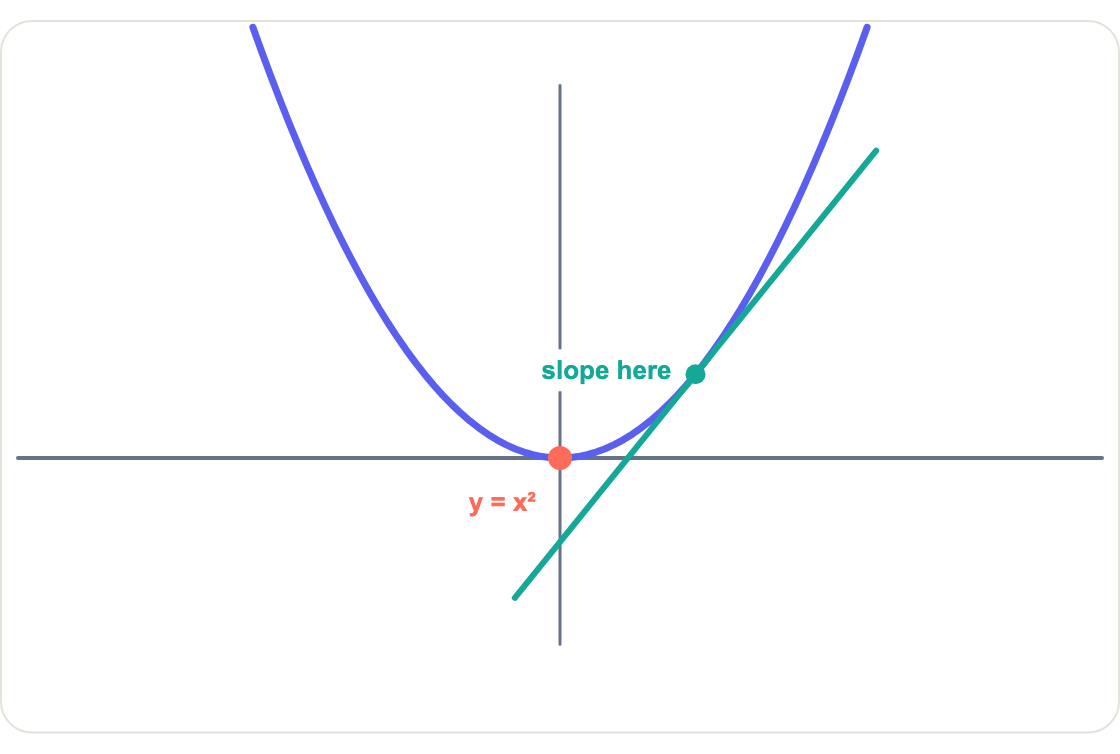
The derivative f′(x) tells you how steep the curve is at each x: its slope. For powers of x there's a one-line rule:
The derivative of xⁿ is n·xⁿ⁻¹. Bring the power down in front, then make the power one smaller.
🪜 The steps
- Do each term on its own.
- Bring the power down and lower it by one. A number already in front gets multiplied: 3x⁴ → 3 × 4x³ = 12x³.
- x on its own becomes just its number (5x → 5), and a number on its own disappears (+7 → 0).
- For f′(a), take the derivative first, then put x = a in.
✏️ Worked examples
1. f(x) = 3x⁴. What is f′(2)?
f′(x) = 12x³. Then f′(2) = 12 × 2³ = 12 × 8 = 96.
2. f(x) = 2x³ + x² − 5x + 7. What is f′(x)?
Term by term: 2x³ → 6x², x² → 2x, −5x → −5, and 7 → 0.
So f′(x) = 6x² + 2x − 5.
⚠️ Watch out
- Derivative first, numbers second. Putting x = 2 in first and then taking the derivative always gives 0, which is wrong.
- Lower the power. The derivative of x³ is 3x², not 3x³.
- Numbers on their own vanish. A flat line has no slope.
🤔 Why it works (if you're curious)
Take x². Step a tiny amount h to the right: (x + h)² − x² = 2xh + h². Divide by the step h and you get 2x + h. As h shrinks to nothing, that becomes 2x, which is exactly what the rule says.
🎯 Try these
- f(x) = 5x². What is f′(3)?
- f(x) = x³. What is f′(2)?
- f(x) = 4x³ − 2x + 9. What is f′(x)?
Answers: 1) 30 2) 12 3) 12x² − 2
This guide is also in the 10MathQ app: tap “📖 Study guide” after a question.